

What Do Five Political Campaign Ads Reveal About Communication in Election Campaigns?


The 2026 elections are approaching, and soon candidates across the country will begin competing for something just as valuable as votes: people’s attention.
But do effective political campaigns always follow the same formula? Is there a common emotional pattern among political ads that achieve the strongest results? Or can different strategies lead to equally effective outcomes?
These questions inspired us to conduct an analysis using the DAIVID methodology.
For this study, we selected five political campaign ads from different contexts. The goal was not to compare candidates or evaluate specific campaigns, but rather to understand how the platform interprets different creative approaches within political communication.
The sample included two ads from one candidate and two ads from another candidate, both drawn from mayoral campaigns held in different cities and contexts during the most recent municipal elections. Since these campaigns did not compete against one another, the intention was not to establish a direct electoral comparison, but to observe how different creative strategies perform when evaluated against the same criteria.
In addition, we included a more recent ad from a political leader currently building national awareness. This allowed us to observe not only differences between candidates, but also differences between ads within the same campaign and across different stages of political communication.
The objective was simple: to examine how different narratives are translated by DAIVID into indicators of attention, emotions, recall, and behavioral intent.
Rather than identifying which ad achieved the best overall result, we sought to understand which communication approaches each campaign adopted and how those choices were reflected across the different metrics analyzed.
The results show that although all five ads shared the same objective—building a connection with voters—each followed a very different path to achieve it.
How Does DAIVID Analyze Political Campaign Ads?
Before exploring the results, it is worth understanding exactly what the DAIVID methodology evaluates in a piece of communication.
In political campaigns, the analysis does not focus on a single aggregated metric. Instead, it examines multiple signals together to understand how the message is being received by the audience.
Among the key indicators analyzed are:
Attention: the ability of an ad to capture and maintain audience interest throughout its duration.
Emotions: the emotional responses triggered by the content, helping identify which feelings are most strongly associated with the narrative being presented.
Recall: the audience’s ability to correctly associate the message with the candidate after viewing the ad.
Behavioral Intent: indicators such as sharing, recommending, and other reactions that help measure the communication’s potential to mobilize audiences.
Beyond these metrics, the platform analyzes dozens of specific emotions and additional signals that help explain why a particular ad generates certain audience responses.
Posso também traduzir o artigo inteiro já adaptando para um tom mais natural de blog internacional (não apenas tradução literal), que costuma funcionar melhor para publicação no site da DAIVID.

Different Paths to Building a Connection with Voters
When looking across the different metrics analyzed by the platform—attention, emotions, recall, and behavioral intent—we observed that some campaigns stood out for their ability to capture attention, while others demonstrated stronger mobilization potential, higher recall performance, or broader emotional profiles.
This highlights an important aspect of political communication: there is no single path to building a connection with voters.
Although all the creatives analyzed shared the same objective, each campaign chose very different emotional territories to shape its narrative. Some focused on trust and credibility, while others sought to evoke hope, gratitude, or identification with the challenges faced by the population.
Below, we explore the key emotional profiles identified in the analysis.
Campaign A — Trust, Hope, and Gratitude
Among all the ads analyzed, this campaign generated the broadest range of positive emotional responses.
Its strongest emotional signals were Trust, Knowledge, Gratitude, Relief, and Hope.
Together, these emotions suggest a communication strategy designed to convey credibility, demonstrate an understanding of the challenges faced by citizens, and simultaneously present a positive vision of the future.
The campaign appears to strike a balance between acknowledging existing problems and reinforcing the belief that solutions are both available and achievable.

Campaign B — Trust, Knowledge, and Satisfaction
Among the ads analyzed, this campaign demonstrated one of the most balanced profiles across attention, recall, and positive emotional responses.
In addition to generating strong levels of Trust, Knowledge, Gratitude, and Relief, it was the only creative to show a significant uplift in Satisfaction.
Together, these emotions suggest a narrative focused on achievement, capability, and clarity of message. The communication appears designed to reinforce perceptions of effective delivery and tangible results while maintaining a clear and accessible narrative.
Beyond its emotional strengths, this campaign also delivered the strongest combined performance in both attention and recall among all the ads included in the analysis.
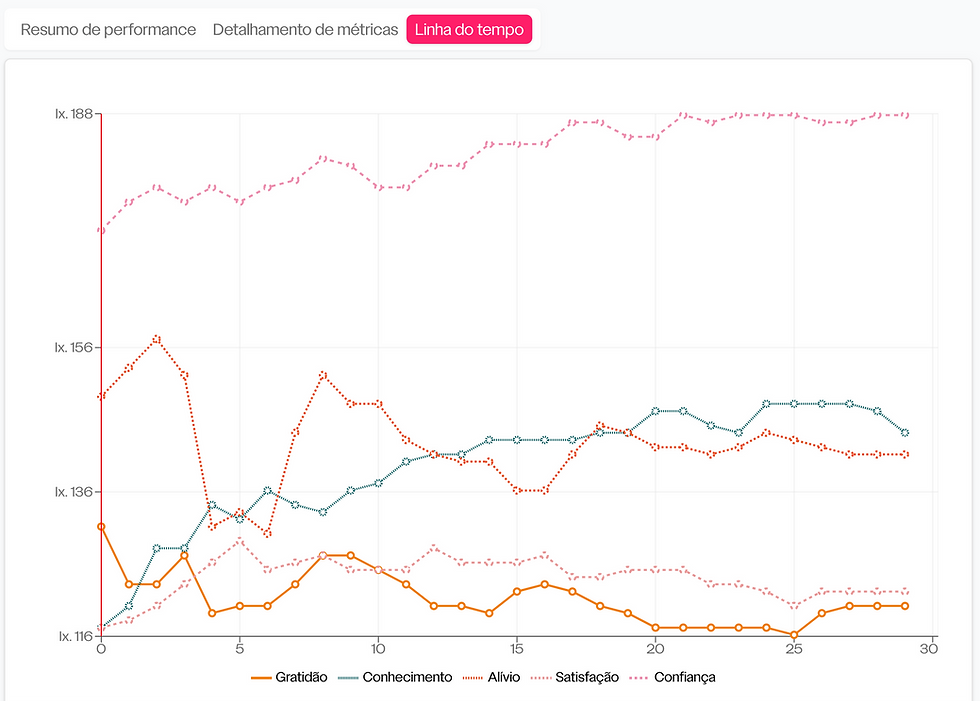


Campaign C — Leadership, Recognition, and Credibility
This campaign generated an emotional profile characterized by Knowledge, Trust, Gratitude, and Admiration.
The presence of Admiration sets it apart from the other creatives analyzed and suggests a communication strategy closely associated with recognition, experience, and leadership.
While some campaigns focus on inspiring hope or connecting with voters through everyday challenges, this narrative appears to build its connection by emphasizing the candidate’s track record, achievements, and perceived authority.
Despite its predominantly positive emotional profile, the campaign also recorded elevated levels of Guilt and Anger compared with the benchmark average. This suggests moments where the communication shifts from highlighting the candidate’s experience and accomplishments to criticizing existing conditions or drawing attention to issues that require change.


Campaign D — Credibility with Strong Mobilization Potential
This campaign generated a more concentrated emotional profile, driven primarily by Knowledge and Trust.
At first glance, its emotional repertoire appears narrower than that of some of the other creatives included in the analysis. However, several behavioral indicators help provide a more complete picture.
In addition to delivering strong recall performance, the campaign stood out for achieving the highest levels of sharing and recommendation intent among all the ads analyzed.
These results suggest a communication strategy focused on building credibility and reinforcing message comprehension, while also demonstrating a strong capacity to motivate audience engagement and advocacy.


Campaign E — Empathy Through Citizens’ Challenges
This campaign displayed an emotional profile that was markedly different from the others.
Its strongest emotional signals were Empathic Pain and Relief, but it also generated the highest levels of negative emotions across the entire analysis.
In addition to its strong Empathic Pain response, the ad recorded the highest scores for Anger (310), Disgust (160), Fear (158), and Discomfort (150) among all the creatives evaluated. Taken together, these results suggest a strategy centered on highlighting real challenges faced by citizens, aiming to create a sense of concern and urgency before introducing a potential solution.
This pattern points to a communication approach built around identification with the difficulties experienced by the population. By showcasing tangible problems and situations that directly affect people’s lives, the ad seeks to generate recognition, relevance, and emotional proximity.
The simultaneous presence of Relief indicates that the narrative does not stop at exposing problems. Instead, it also attempts to offer a pathway forward and a sense of resolution.
Among all the creatives analyzed, this was the campaign that came closest to an empathy-driven strategy focused on the everyday challenges faced by citizens.


What Do the Data Tell Us About Political Communication?
Perhaps the most interesting insight from this exercise was seeing how campaigns that appear similar on the surface can be building fundamentally different emotional connections with voters.
Before conducting the analysis, it would have been easy to categorize all five ads simply as examples of political communication. However, a deeper examination of the data reveals distinctly different narratives at work.
Some campaigns are built around hope and gratitude. Others focus on leadership and recognition. Some prioritize the development of credibility and trust, while others seek to connect through the challenges and concerns experienced by citizens.
One of the key lessons from this analysis is that, in an electoral context, no single metric is sufficient to explain a campaign’s effectiveness. Attention, emotions, recall, and behavioral intent each reveal different dimensions of audience response. Looking at them together provides a richer understanding not only of whether a message resonates, but also of how that impact is being created.
Another noteworthy finding is that negative emotions do not necessarily operate in isolation or in opposition to positive emotions. In some campaigns, they play an important role in the narrative structure, particularly when the message seeks to highlight problems, create a sense of urgency, or encourage reflection on issues that require change.
This is precisely one of DAIVID’s core strengths: transforming what would traditionally be interpreted subjectively into observable, measurable, and comparable data.
As the 2026 elections approach, understanding not only what is being communicated, but also how that communication is being received, may become an increasingly valuable advantage for campaign teams, political marketing professionals, and researchers alike.
Comments